Monday, June 29, 2015

Chimes in the Wind

A second guardian watched us from across, both warding and welcoming.


Silent jingle filled the air, growing stronger as we approached, like a mystical melody it surrounded the temple.


We looked up, and hundreds of tiny bells lined the roof, their chime rising, falling, and blending with the wind.


Friday, June 26, 2015

Why don't we see stars in the city?

It’s night, it’s dark, and the moon is out. You walk out onto the balcony, or the street, or even the local park, look up and there’s nothing. Perhaps Venus’ bright dot, and a few other prominent celestial lights, but beyond that a dark, grey velvet hangs above you.
Maybe you’ve been in the countryside once, or maybe you’ve never left the city, but you’ve seen plenty of programmes, and pictures and books to know something isn’t right. That a veil lies between you and the sky because the millions of sparkly dots we call stars are missing.
A sad existence under a starless sky, making you question where did the nightlights go? Why can’t we see them hanging above the tall buildings of our cities?


Star visibility depends on weather conditions, air humidity and geographical location, with more stars visible in dry deserts and less in warm, wet equatorial tropics.
But the biggest impediment is pollution. Not car exhausts and smog, not too much anyway, but light pollution.
Modern metropolises are lit with blinding lights. You can’t find a single street or building, not one you’d like to wander into anyway, that isn’t illuminated 24/7. Windows, streetlamps, billboards, all project their light into the sky, often needlessly and with great electric costs, obscuring the fainter starlight. But it is the price of civilization. Even if it affects wildlife and takes away our stars.
With all this light on the ground, is it any surprise the sky remains vacant?


So if you wish to stargaze, you may always find a nice cottage in the countryside, far away from the big city, and enjoy a few nights under a starlit sky.
But not all is lost for city dwellers as new policies, technologies and designs are being implemented to combat light pollutions. In many cities streetlamps are redesigned to point downwards and limit the light projected at the sky. They are also fainter, still enough to see, while limiting power consumptions. Additional laws are being passed to limit night light use in big cities. And finally, everyone can make their personal contribution by turning off inessential lighting whenever possible.
And one day, we may yet see the stars and even the milky way again above our cities.


References and related reads:


Wednesday, June 24, 2015

Daredevil

IMDb

This week, Marvel’s Netflix powered, 2015, Daredevil series. 
The show is about a blind lawyer, Matt Murdock, played by Charlie Cox, whose remaining senses sharpen to unnatural degree as a result of his loss. By day he prosecutes criminals, and by night he fights crime barehanded in Hell’s Kitchen, the formerly poor neighbourhood he grew up in.
I wasn’t optimistic when I heard about this title. After the movie, and seeing it was Netflix produced, hence having a low budget, I suspected it wouldn’t turn out all that good.
Well, I was wrong.
Daredevil is cleverly written, well acted and choreographed tv show with great mood and realistic representation of combat. When people fight, they fight to the end in a bloody, tough competition of endurance and real consequences to blows and wounds. The show is shot in New York and makes good use of its locations. The only complaint I’ve heard is they didn't CGI in Stark’s tower, considering the series take place after the alien attack, which is often referenced.
My verdict is: a must watch for both fans of darker comic heroes and casual action series viewers.


http://cdn.idigitaltimes.com/sites/idigitaltimes.com/files/2015/04/07/daredevil-netflix-header.jpg


But let’s examine episode one “Into the Ring.” As usual, spoilers ahead.

It opens with a man wandering down a street jammed with traffic. An accident has occurred, evident by the crowding people and blowing horns.
The man is looking for his kid, who, we learn, pushed an old man out of the way of a truck and as result was splashed with chemicals. He rubs his eyes, spreading the chemicals and his vision slowly fades.
So immediately, in less than five minutes, we get a very visual establishment of who our character is and what happened to him. Introduction of backstory without making the actual story drag, something a lot of series need to learn how to do.
We continue with a confession scene, which I admit drags a bit. When I first watched it, I remember thinking: come on, move on already, what are they even talking about? But as the series progressed and concluded, I realised it was also a clever foreshadowing of the events to come.
Five minutes in, we get a well choreographed action scene as our hero dispatches a few criminals trying to traffic off young women. Again, many praises of how realistic the fight is depicted.
Next we are introduced to Matt’s job, his newly started firm, and his best friend and main supporting character Foggy Nelson, played by Elden Henson.


Right after the speedy establishment of our protagonists and their character dynamics, the chick of the show appears, Karen Page. Played by Deborah Ann Woll freshly out of True Blood, Karen is the shared romantic interest of both heroes in the books. In the series, she becomes their first client and also secretary.
Before I proceed, I want to mention that I really like how the makers played her character, especially towards the end, creating this ambiguity about whether she really is a goodie good girl and hinting at a dark past.
So the scene starts with her waking up covered in blood by a dead body. You can’t do a better job to establish a mystery.
She’s arrested and interviewed by Matt and Foggy who agree to help her pro bono.
After meeting our heroes, it's time to see our villain. Or in this case, his right hand, Wesley, played by Toby L. Moore, as he “hires” a prison guard to set up an “accident” in Karen’s cell. Again nice introduction, to the point, showing him as a powerful man with many people in his pocket/blackmail book.

http://vignette1.wikia.nocookie.net/marvelmovies/images/7/7d/Into_the_Ring_Wesley_and_Clyde_Farnum-1.png/revision/latest?cb=20150428205646

The guard, a scaredy old man, fails to kill her, which further proves her innocence and helps our lawyers bail her out.
But she’s still in danger, and as they delve deeper into her case and the reasons before the attempted set up and murder, they agree to watch over her. Karen reveals that she saw a money laundry file and suspect that’s why they are trying to kill her. She lies about copying the file, something Matt notices with his lie detector hearing.
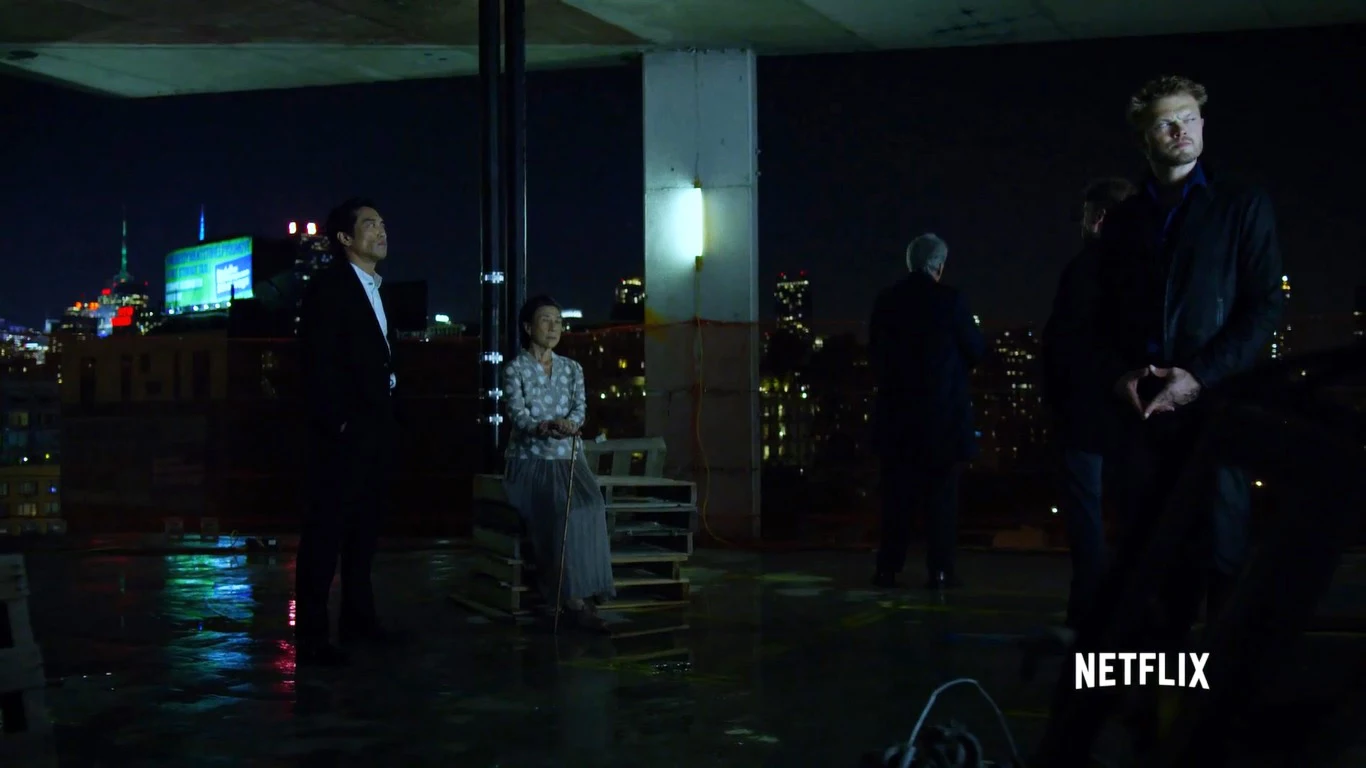
After seeing a glimpse of the villains, we are introduced to the crime circle of the city, the head of the Triad, the Mafia, the Russians, the Yakuza and our mysterious main villain represented by Wesley. A well rounded, multicultural crime organisation, each part responsible for a different “industry,” from drugs, to trafficking, money laundry, the black market, etc.
    So our crime lords learn about the earlier trafficking hiccup and are not happy that the Russians couldn’t deal with our masked hero.

http://screencrush.com/files/2015/02/5-hachiro.jpg

    Not wanting to put anyone else in danger, Karen leaves in the night to recover the flash drive from her apartment. She is attacked, of course, but Matt saves her, taking the drive to make it public and clear her name.
    In the end, the day is saved, and the firm gets a new secretary.
    Overall a well rounded, action packed episode that introduces all the main elements and characters without rambling or dragging on forever. The show keeps up the clever storytelling and provides a satisfying end of the season.
    If you decide to give it a watch, you won’t be disappointed.

Friday, June 19, 2015

Why do we hate the sound of our own voice?

I hate my voice. Every time I hear a recording I cringe. I mean it’s not that awful, just something about hearing it makes me shudder.

Why is that? Why do our own voices creep us out?

Part of it is because our voice sounds different to us than to the outside world. So when we hear a recording of a disembodied, foreign voice that is our own, it can be a little unnerving. Add a bit of mechanical static and we’re having a horror movie like experience.

But why does it sound different?


When we talk, and listen to ourselves talk, we hear our voice in three separate ways. First, we catch the sound that leaves our mouths externally through our ears. But soundwaves also pass from our vocal cords to our hearing apparatus through a filter of flesh and bone, transforming in the process into a more muffled version. Finally, we feel the vibrations of our voice, the tremble of the vocal cords and the rumble of the sound itself, which adds another layer to what we perceive.

So in the end, what we hear is very different than what is, and when we’re given a recording of it, it feels foreign, contradicting and we tend to strongly dislike the sound of it.


References and additional reads:


Wednesday, June 17, 2015

Arrow

IMDb


Sigh.
Where do I begin with this one?
DC’s Arrow. A story about a spoiled billionaire’s son who spends five years on a hellish island and receives the epiphany to become a vigilante and right his father’s wrongs. He returns home, where led by a notebook left by his late father, he embarks on his mission to rid the city from the corrupt and powerful.
Doesn’t sound too bad, does it?
Any premise can be ruined by a photoshop filter, plastic characters, cliche plotlines and enough melodrama to keep the local grandmas talking for a few decades to come.

I can’t really put my finger on it. It’s well shot, okay acted, maybe it’s the show you’ll love, a dark brooding hero, some decent action, spiffy sidekicks, some romance, too much family drama and unnecessary plotlines... Yeah, let’s just say I didn’t enjoy it.
For me, Arrow is bland, boring, crowded, and features a toad faced protagonist who hardly moves his neck. Pass.


But let’s take a look at the Pilot episode before burying the DVD’s in the backyard. Oh god... Does that mean I need to watch it again? Heaven’s help me…
Also spoilers ahead.


The episode opens with a man running in a forest. Shortly, we see that he’s on an island and trying to get the attention of a nearby boat by lighting a fire in the most convoluted way. With an arrow, from a hill, hitting a pile, on the beach, and sure if he was far but it looked like he purposely ran all the way to the other side to light the bloody fire.
Luckily, the old chinese fishing couple spots his fire and whisks him away.
Meanwhile, Oliver, as the narrator who won’t shut up, tells us all about how he needed to forge himself into the man who can survive the island. All nice and well and dramatic but why couldn’t we see that through the actual action and scenes and all that? The series do have those, so what’s the point of all the narration?
Is it to keep with the spirit of a comic book? Well, it’s annoying. Narration can be useful, but in Arrow, it’s quite unnecessary and exists only to hammer dramatic tension into the viewer.
That said, I do think the series is well shot and well composed. Apart from the plastic filter that makes things look extra glossy and extra fake. Also the dark, gritty feel can get rather tedious, but that lets off as the series progresses so I’ll leave it alone.
But moving on. Next we get the exposition from the doctor about all the scars and fractures Oli had. “The Oliver you lost, may not be the one you found.” Whooo, dramatic...
Then we meet the whole family, and Rosa, the maid, who we never see again after this episode.
And so we get this nice, overlong establishment of everyone we should care about in the series. Sigh.
When is the action coming back? I’m bored.
So we continue meeting people and the next on the list is Lauren, Oliver’s ex girlfriend. Whom no one bothered to tell of Oliver’s return. Even if her sister died on the boat that shipwrecked. No, poor Lauren need to learn it from the news. That’s okay though, I never liked her anyway. And her addiction/alcoholism issue they play in season 2 was a joke. Did I mention Oliver cheated on lauren with her sister?
And we get more dramatic narration, and more flashbacks, and more new characters... Where’s the guy in the green hood shooting arrows at people that I was promised? Come on give me something to chew on other than endless disappointment.


And an awkward family diner follows. Because of course we need to have one in a family drama. Wait, you say this is comic book action series? I thought it was a family soap opera.
And, flashback.
I’m getting a pattern here. Boring character introduction, boring backstory flashback, I get it, you’re taking it slow in an action series, but my god just move on already.
You know, I’m gonna go real speedy here. Oliver meets Laurel, who hates him, but loves him, but hates him, and you get the idea. She’s boring, and he’s boring, and they’re all boring. And they talk. And she’ll date his best friend. Who’ll die. And Oli will swear to never kill again. But I digress.
About 15 minutes in, we get the first action scene where… oh wait, flashbacks to interrupt our scene. Oliver is kidnapped by some schmuck with a taser who interrogates him about his father. And then he kills them all. Yay... Not before the obligatory snappy dialogue exchange though.
And the sound explodes. Did I mention the sound is really badly levelled through the entire series? It’s something I noticed happen in most DC powered TV projects.
So they fight, and even the action scene drags on forever, yet it’s over in a blink and we go back to meeting characters. Laurel’s father that is, who’s also a detective. With a personal vendetta against Oliver, of course.
And it’s all flashbacks, new characters and establishment until the end. And one obligatory party scene. Oliver also takes down a baddie at some point. In case I forgot to mention. It’s all rather dull.

From what I hear, they also introduced magic, or the like, later on. You know, sometimes, even if your universe contains certain elements, it’s best to keep them separate. Because honestly, you can hardly sell to me that oh by the way magic/super powers exist in a series that have been playing it straight so far.


I think my biggest problem with Arrow, other than the over-packed plot, is the drama. It just tries too hard to build dramatic tension to the point we’re repeatedly smacked in the face with it. The series feels more like a spin off of the Bold and the Beautiful rather than a comic book adaptation. And sure, I understand this kind of purple drama is often found in comic books, but I still find it unnecessary in how overblown dialogue and performances can be. Not to mention soundtrack. Sure, it’s pretty, but if you play dramatic music over a boring scene it doesn’t make it any less boring.
That said, we do get some nice performances though the protagonist is kind of wooden. Might be due to the character, not the actor, but still he can be such a non presence it’s startling. And that’s another problem I had, how exaggerated the characters can be at times. Exaggerated in a single trait that is. Usually brooding, or perky, or dramatic.


The series is not so bad as to make me sick to my stomach, but elements often breach the line between decent and trash making it mediocre at best. Might be just tastes, other people might be tickled the right way by the exaggerations. I certainly wasn’t.
Arrow was boring, dragged out, over packed, exaggeratedly dramatic, and I only forced myself to watch it because everyone else is going crazy over it and I wanted to see what the deal was. I only managed to the end of season 2, when I finally said, you know what, you bore me series, you bore me, I’d rather go watch paint dry.
I just don’t like it. I genuinely do not like these series.


Monday, June 15, 2015

Return

Back we went along the dusty road, back towards the temple. When we near, to our surprise, people roamed around the gates. A few new cars had arrived, unfortunate tourists who’d also mistaken the dates.
Unfortunate, but braver than we were, they rang the bell and got an answer. The keeper of the gates appeared, agreeing to let us in and see the temple.
The moral had been clear. Even if you see no answer, still ring the bell, you never know who’ll listen.
Together, we walked into the courtyard.
Where a silent guardian greeted us.


The gates ever under his vigil.


But another warden announced our arrival, calling to every creature with its howl.


Friday, June 12, 2015

Why do we love sugar?


Cakes, and strudels, and creme puffs, and cookies, and I’m sure there’s at least one kind of sugary sweet that can make anyone’s mouth water. But have you ever wondered why this particular food tickles us more than other?

The simple truth is carbohydrates, especially glucose, are a very efficient source of energy, and as such are favoured by both our body and mind. This developed a long, long time ago, in our early history, when tribes roamed the world in search for subsistence. It was integral to pick out the best fuel source possible so that we could go on another day so we became hard wired by evolution to recognise and prioritise sweetness.
    Our bodies use two main types of energy reserves, fats and sugars (glucose). Out of these, sugar is the preferred fuel for the brain, so is it any surprise that we are inadvertently drawn to a chocolate glazed, creme filled doughnut?


But it goes even beyond that. When we do something our survival instincts approve of, our brain releases hormones that make us feel good. 


Sugar, itself, isn’t bad. If we don't count the increased chance of cavities. No matter how much fruit and veggies we eat, they won’t hurt us. The real problem came when we refined sugar to its super sweet white powder form.


Now we could get the compound we craved with no limits or restrictions. So that’s great, you’d think, we can get more energy. Well it’s not exactly like that. As any system, our body has limits to what it can use and store. When we eat a whole box of delicious chocolate cookies, we can’t process all of it. But nothing goes to waste is the motto, so when we can no longer absorb the sugar, and our livers have resupplied on glycogen, the body turns the rest into fat. And that’s something nobody likes.


Related reads and references:

Wednesday, June 10, 2015

Constantine

IMDb

I had planned to review another DC series this week, but because Constantine was recently discontinued, I decided to write about it instead.
The show follows John Constantine, played by Matt Ryan, who uses his knowledge of the occult to battle all things evil and demonic. The series happen after his great failure to save the soul of a little girl, Astra, from a hellish demon. This event shatters his magic dabbling group and shakes his faith in himself to the point he starts doubting what is good and what is evil.
But our hero can’t stay away from the fight for long. Called to action by an angel and the desire to pay the devil back, he faces off against a new threat to the mortal realm.
The series is now officially over after just one season, and while they weren’t brilliant, they were good and deserving of continuation in my opinion. So definitely give it a watch.


But let’s take a look at episode one, Non Est Asylum. Spoilers ahead.

The episode opens with Constantine in a mental institution, and we shortly learn he checked himself in because in “his line of work, there are days one needs to forget.” And the series are already saying things better than I could ever summarise. Short, to the point, and relevant exposition. Mostly shown rather than told as the asylum scenes demonstrate the protagonist’s desperation and hint at the gravity of past events.
Mostly, Matt Ryan’s acting and the clever dialogue work together to make the backstory presentation work. The scenes actually interest the viewer and don’t overstay their welcome before we move to the more relevant events in the present.
It isn’t long that the supernatural comes knocking in the form of a spirit, he once knew, and Constantine has no choice but to follow its call, and warming.


Liv, played by Lucy Griffiths, is the daughter of a psychic friend of his, and she’s in trouble. The demons are after her.
Here I need to note that the character is somewhat stupid when faced with life and death situation. I understand she’s just a normal girl, but it didn’t stop my mind from screaming “just run bitch,” every time she fell over and half heartedly crawled away from danger instead of springing to her feet and sprinting the hell away. She’s just a bit too clueless, and her self preservation instinct is close to nonexistent. But I guess I can squint and accept it, considering the supernatural nature of the threats.
It is at this point that we meet Manny, the angel, played by Harold Perrineau, who is, through the series, pushing Constantine along his path. The angel reveals that while Constantine was away, a new evil has entered the picture, and through the series we uncover piece by piece its identity and goals.
Now we don’t know whether Constantine is walking towards darkness or light, and he constantly needs to rely on faith he no longer possesses. This is one of the main themes of the series even if our motivations are noble can we really know if our actions lead to good or evil? Do we serve Heaven or Hell? The greater morality of the quest and Constantine’s action remain vague, and in the context it works. Saving the world is left in the hands of humanity that often can’t see the greater picture and has to depend on its own interpretation of events and morals.
Right from the start, we are also told redemption isn’t the goal. Constantine’s fate is sealed. It is his duty, rather than reward, that motivates him.


But back to Liv. After the death of her neighbour and the constant attacks to her life, she agrees to let Constantine protect her. Together with his friend, the undying Chas, played by Charles Halford, they take her to a safe house, and reveal the truth about her father, and her heritage as a seer.
Then, long story short, the only way to save her is to defeat the demon, and so they lure the beast and exorcise it. Only problem is, the creature feeds on electricity, and in the middle of a modern city, that isn’t exactly scarce.
They do manage to defeat it, saving the day, but making this choice also has its costs. While they were fighting the demon, an accident she foresaw came to fruition. So they stopped one evil at the cost of letting another happen.
Constantine is a lot about action and consequence. Even if you defeat evil at one front, it will stab you on the other, and that is what makes things exciting. You never know where the forces of darkness will retaliate from, and you never know whether the actions of the hero no matter how noble will aid Heaven or Hell.


In the end of the episode, Liv decides all of this is too dark for her, so she walks away while she can. But not before before leaving Constantine a scary map to alert him of the key events as they happen.
So that’s Constantine in a nutshell, the struggles of mankind in the face of greater wars and machinations between Heaven and Hell.
The acting is okay, Matt Ryan’s performance as Constantine definitely dominates every scene, though the actress playing Zed, a later sidekick, could use some lessons. And the plot is decent, well thought out, it always delivered on its build up.
It is truly a mystery to me, how even though Constantine got a substantial number of positive reviews, it got cancelled. I guess the market just wasn’t feeling in the mood for a new fantasy, gods and devils, series. I sure was eager for some of that. Constantine delivered, and I wasn’t disappointed, but I guess one season of promising build up is all I’m getting. It’s sad when producers disregard niche audiences even when a product is competent.